
A trailer light problem can be easy to describe badly. A message saying that the lights are acting up leaves the next person guessing whether the issue involves a marker lamp, a brake signal, an intermittent connection, or an entire group of lamps. A useful driver routine combines a systematic inspection with a precise report and a clear decision about whether the vehicle can be operated. The goal is not to turn the roadside into an electrical workshop. It is to identify what is visible, keep the vehicle secure, and get the right assistance without overlooking a required signal.
Use a repeatable walkaround order
Inspect the tractor and trailer through the carrier's approved pre-trip process rather than checking only whichever lamp catches your eye first. Work in an order that helps prevent omissions, including the rear of the trailer and any equipment that changes with a trailer swap. Look for missing lenses, damage, dirt, poor visibility, and lamps that do not perform their intended function. Use an approved method to check functions that require another person or a built-in test feature. Keep the vehicle secured throughout the check.
The federal lighting requirements in 49 CFR 393.9 provide an official reference for required lamps and their operation. Do not decide that a fault is acceptable simply because some neighboring lights still work. The function and applicable requirement matter. Ask the carrier's maintenance or safety team to resolve uncertainty before departure. A driver should not have to interpret an unfamiliar lighting configuration by comparing it with a different trailer parked nearby.
Name the lamp and the behavior
Describe the location from a consistent perspective, such as the trailer's left rear turn signal or right side marker near the rear axle. State whether the lamp is completely out, dim, damaged, obscured, or intermittent. Note whether the fault occurs during a particular function or affects several lamps together. This detail helps maintenance distinguish a local lamp problem from a wider connection or supply issue. Avoid guessing the failed component when all you have observed is the visible symptom.
A short photograph can help when the truck is safely parked and the required function is active through an approved method. Include enough surrounding area to show which lamp is being discussed. A close-up without context may leave the technician unable to identify its position. Do not hold a phone while driving to capture flickering behavior. If an intermittent problem was noticed during travel, stop safely, record what happened, and follow the reporting process rather than attempting to reproduce it in traffic.
Check what can be observed safely
Inspect accessible connector and cable condition through the approved procedure. Look for obvious damage, a cable hanging where it can be pinched, or a connection that is not properly secured. Keep hands away from unsafe positions and never crawl beneath an unsecured vehicle to follow a wire. Do not probe live circuits, bridge terminals, bypass protection, or substitute improvised wiring. A simple-looking fault can involve damaged insulation, an incorrect connection, or a problem outside the driver's authorized work.
If the carrier permits a specific basic correction, follow that procedure exactly and verify the result. Otherwise, leave repair to qualified maintenance personnel. A temporary improvement after touching a cable is not proof that the underlying issue has been resolved. Report what changed and request proper inspection. The useful boundary is the difference between observing an accessible condition and undertaking electrical diagnosis. Keeping that distinction clear protects both the driver and the equipment.
Inspect again after a trailer change
A tractor's lights working correctly does not establish that a newly connected trailer is ready for the road. Include lighting in the full coupling and departure check for the actual combination. Confirm that cables are routed and secured as intended and that the vehicle's required functions can be verified. A trailer may have been moved, repaired, or parked for some time since its last use. The next driver's inspection is the opportunity to discover a problem before it becomes a nighttime roadside stop.
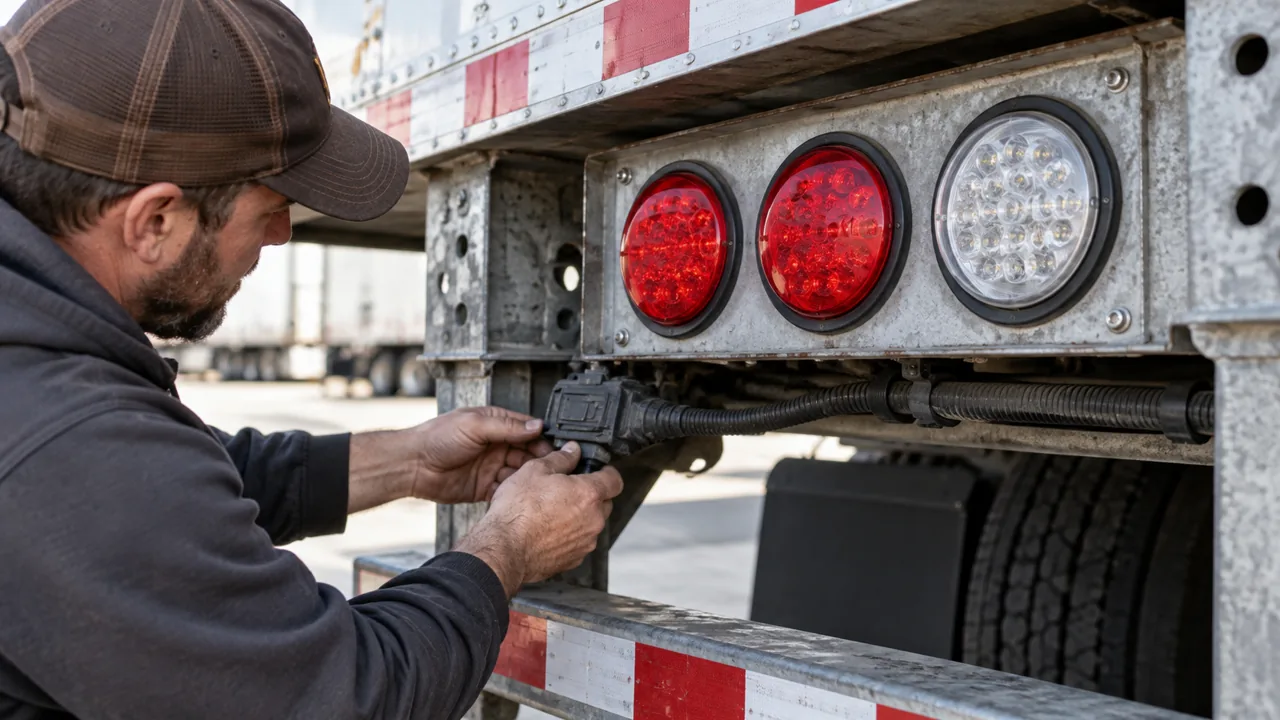
Likewise, verify lighting after an authorized repair rather than treating the maintenance visit as the final check. Make sure the reported function now works and that the correction has not left another issue visible. If the fault was intermittent, explain the conditions under which it appeared so the technician can evaluate the repair appropriately. Keep the defect report connected to the correct trailer number. Similar trailers and hurried swaps can otherwise send a repair request to the wrong unit.
Account for dirt, weather, and visibility
Road spray, snow, and mud can reduce how well another road user sees a lamp even when it illuminates. Clean accessible lighting surfaces through a safe routine and use materials suitable for the equipment. Do not climb onto unstable surfaces or stand in an active traffic lane to improve a light's appearance. Choose an appropriate stopping area and follow the site's pedestrian and vehicle procedures. If damage or obstruction cannot be addressed safely, report it and obtain assistance.
Nighttime makes an unresolved issue more consequential, but daylight is not a reason to ignore required lighting. Conditions may change before the trip ends, and some functions communicate braking or direction regardless of the time. Avoid a plan that depends on completing the entire journey before sunset. A delay, tunnel, storm, or change of appointment can remove that assumption. Make the operating decision on the condition of the vehicle and the applicable requirement, not an optimistic arrival estimate.
Make the maintenance request actionable
Send the truck and trailer identifiers, exact location, observed function, and whether the issue is constant or intermittent. Include when it was last checked and any authorized action already taken. Tell dispatch whether the vehicle is parked and awaiting a maintenance decision. This prevents a vague report from being mistaken for a minor note that can wait until the end of the week. Keep relevant photographs with the report instead of scattering them across unrelated message threads.
The driver equipment responsibility in 49 CFR 392.7 is another useful reference when discussing readiness for departure. Reporting a defect and obtaining an appropriate release decision are different steps. Do not assume the act of sending a message makes the vehicle fit to operate. If instructions are unclear, ask for clarification from the responsible maintenance or safety contact while the truck remains secure.
Close the loop before returning to service
After the issue is addressed, document the outcome through the carrier's process. Confirm that the correct unit was repaired and that any outstanding concern has been communicated to the next driver. Keep the report factual: which function failed, what maintenance confirmed, and what was checked before departure. A clear history makes a recurring fault easier to investigate and prevents drivers from repeatedly treating the same intermittent problem as a new, isolated event.
Reliable lighting checks are not complicated when the routine is consistent. Inspect the complete combination, name the exact symptom, observe only what can be checked safely, and obtain qualified help for diagnosis and repair. The result is better communication and fewer assumptions at the point of departure. It also gives maintenance a useful starting point, so the next conversation can focus on solving the fault rather than discovering which light the driver meant.
