
A tire problem can turn a routine long-haul day into a roadside stop with a loaded trailer and a ticking delivery appointment. Many failures have warning signs that a driver can notice before a tire gives up: a repeated pressure loss, unusual heat, visible sidewall damage, or uneven tread wear. A careful check does not replace a tire technician, but it helps you recognize when the truck should not continue without service.
There is no useful universal PSI target for every semi-truck tire. The right cold inflation pressure depends on the tire, axle load, wheel position, and the vehicle or fleet specifications. A number printed on a sidewall is not automatically the pressure you should use for the load. Keep the carrier's tire chart or maintenance instructions accessible, and ask a qualified tire professional when the correct setting is unclear.
Start with a repeatable walkaround
FMCSA tells commercial drivers to complete pre-trip safety inspections, paying particular attention to tires and brakes in its road-safety guidance for truck and bus drivers. A tire walkaround works best when it follows the same order every time: steer axle, drive axles, and each trailer axle. Look at both sides of every tire, the valve area, and the space between duals. A tire hidden behind the outer dual is easy to overlook if you only view the truck from a distance.
Look for cuts, exposed material, bulges, missing chunks, objects embedded in the tread, and signs that one tire is carrying a different load or wearing differently from its mate. Check for obvious leaks, damaged valve hardware, and wheel problems that deserve maintenance attention. A visual inspection can reveal damage, but appearance alone cannot confirm pressure. A radial commercial tire may look acceptable while its inflation is too low for the load.
Do the inspection on stable ground away from moving vehicles. Do not crawl under a trailer or place yourself between the truck and traffic to get a better view. If access is poor, move to a safe inspection area or get maintenance help. The goal is to find a problem early, not create a new hazard while looking for one.
Measure pressure with the right reference
Use a gauge suited to commercial tire pressures and compare the reading with the carrier-approved specification for that axle and load. For the most useful baseline, check when tires are cold, before the day's driving has heated them. NHTSA's tire-safety guidance explains the principle: tire pressure rises as tires warm in use, and a pressure-monitoring alert is not a substitute for a gauge check. The specific commercial-truck target still has to come from the truck, tire, and fleet guidance.
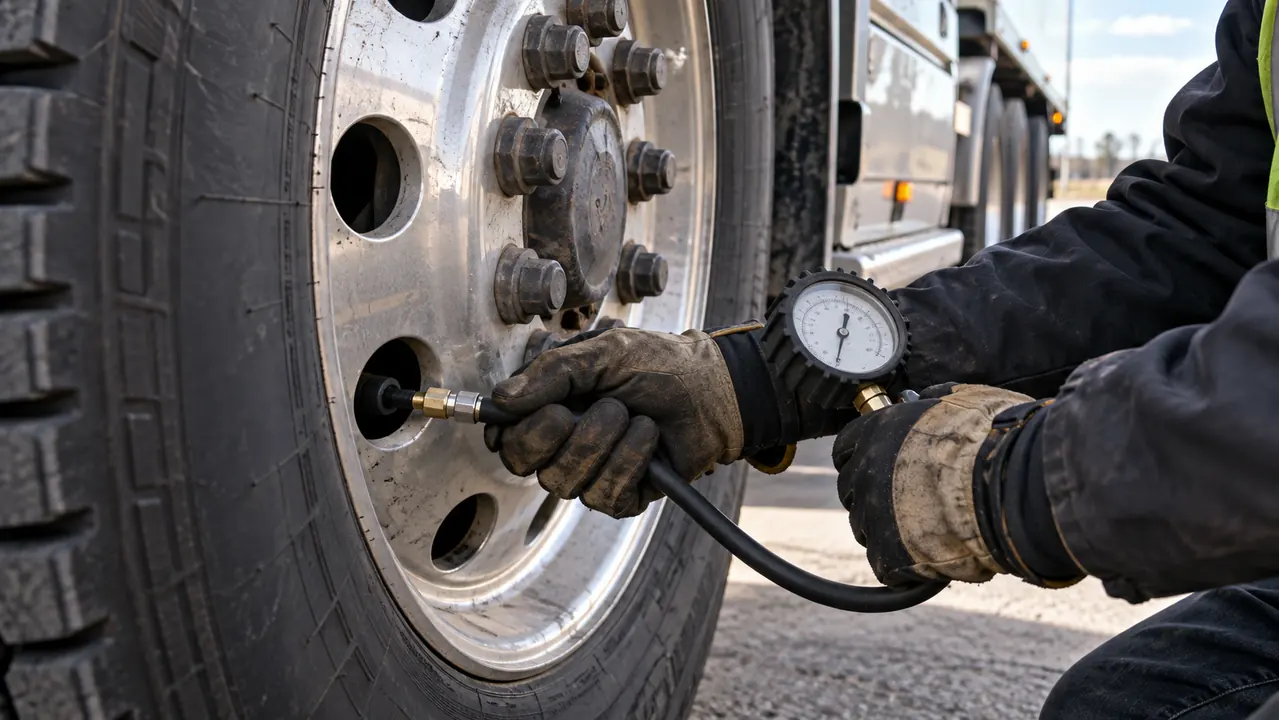
Put the gauge squarely on the valve, note the reading, and replace the valve cap. Record measurements consistently when the fleet requires it. If one tire is low, do not just add air and forget it. Check whether the pressure loss repeats at the next safe stop and report it so the leak can be diagnosed. A tire that repeatedly needs air may have a puncture, valve problem, rim issue, or another defect that inflation alone will not repair.
Do not confuse a warm reading with a cold target
A pressure reading taken after hours on the road may be higher than the cold setting because the tire is warm. Bleeding a healthy warm tire down to its cold target can leave it underinflated after it cools. If a warm tire appears low or one tire differs significantly from comparable tires, ask maintenance how to evaluate it rather than making a guess. The FMCSA tire advisory card points drivers to the vehicle placard, certification label, service information, or tire supplier to identify correct inflation.
Ambient temperature can change between a warm yard and a cold mountain morning. That is another reason to keep a consistent cold-pressure reference and recheck when conditions shift. A tire-pressure-monitoring system or automatic inflation system can help a fleet detect a problem, but it has limits. Learn what the dashboard alert actually covers, which wheel it identifies, and how the system reports a fault. Never assume that no warning means every tire and valve is in good condition.
Make a useful check during the route
At a fuel or rest stop, take a brief walk around the tractor and trailer. Look for a tire that appears low, a new cut, an unusual smell, visible smoke, or a tire rubbing against a component. Compare wear across similar positions. A driver who has seen the tires before departure is more likely to notice a new change. Do not touch a tire or wheel that may be dangerously hot, and stay clear of the path a tire could take if it fails.
Pay particular attention after striking a pothole, curb, road debris, or an object you could not avoid. Even if the truck continues normally, damage can appear later. Tell dispatch or maintenance what happened and where, so the incident is not lost between shifts. A short note with axle position, symptom, location, and time is more useful than “one tire looks bad.”

Know when a technician needs to decide
A tire with a bulge, exposed cords, obvious leak, serious cut, or other significant damage needs professional evaluation. The same is true when a pressure alert persists, an automatic inflation system repeatedly runs, or the truck develops a new vibration or pull. Do not try to “make the delivery” on a tire you believe may fail. Choose a safe place to stop, set the parking brake, follow the company's roadside procedure, and give maintenance the exact wheel position and symptoms.
Federal rules also set minimum conditions for tires in commercial service. The text of 49 CFR § 393.75 covers conditions including exposed ply or belt material, separations, certain cuts, and tread depth. Those legal minimums are not a maintenance plan: a tire can warrant service before it reaches a prohibited condition. The vehicle owner and qualified technician should decide whether it can safely remain in service.
If a tire fails while driving, control the vehicle, reduce speed smoothly, and move to a safe location as conditions permit. Do not make a sudden move across traffic to reach an exit. Once stopped, use the company's emergency and roadside-warning procedures and stay out of live traffic. The exact response depends on road conditions, vehicle behavior, and the location of the failed tire; driver training and carrier policy take priority over a generic checklist.
Keep a simple tire log
A short record helps distinguish a one-time reading from a pattern. Note the date, tractor and trailer number, wheel position, measured pressure when cold, visible damage, and who you notified. If air was added or a tire was replaced, record the service details and check the position again at the next appropriate opportunity. This gives the next driver and maintenance team a clearer picture than a verbal note at the end of a long day.
For owner-operators, consistent records can also help compare tire wear across routes and identify alignment, suspension, or loading issues. They do not need to become a complicated spreadsheet. A reliable pre-trip routine, a few clear notes, and timely maintenance communication are enough to prevent many small warnings from disappearing into the daily rush.
A practical decision sequence
- Before departure, inspect every tire position and check cold pressure against the correct vehicle and load guidance.
- At planned stops, look for changes in shape, wear, damage, leak signs, or dashboard alerts.
- Document the exact wheel position and symptom; tell maintenance early.
- Do not bleed air from a normal warm tire to match a cold-pressure target.
- If damage or a persistent alert suggests a safety issue, stop in a safe place and arrange qualified service.
Good tire care is not a matter of guessing a single PSI for every truck. It is a repeatable process: know the proper specification, measure at the right time, notice changes, and act before a minor problem becomes a roadside emergency. That process protects the schedule, the freight, and everyone sharing the highway.
