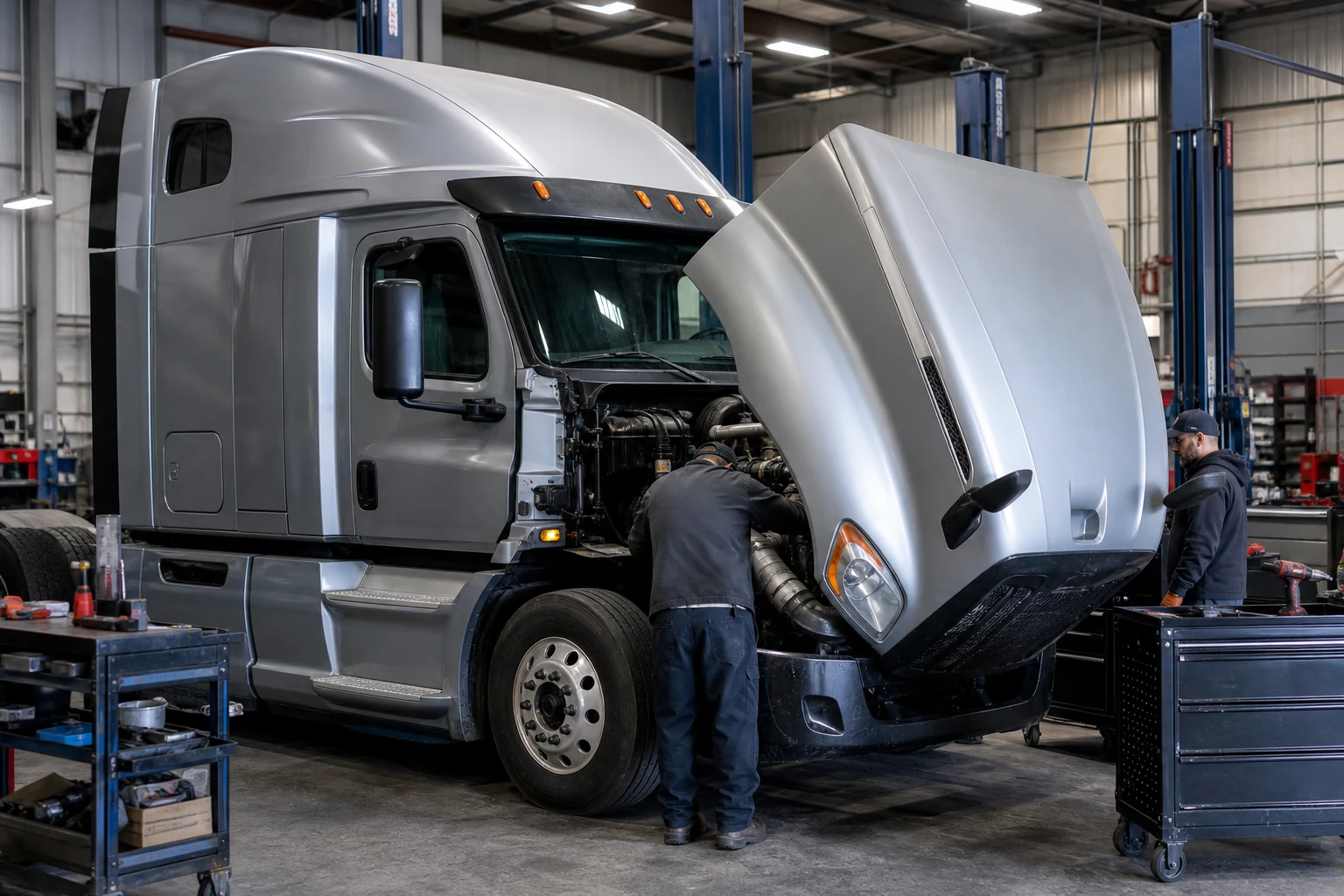
Owning a semi-truck can be profitable, but one major mechanical failure can quickly turn a good month into an expensive one. Modern Class 8 trucks contain complex diesel engines, automated transmissions, emissions systems, electronic controls, turbochargers, and other components that can cost thousands — or even tens of thousands — of dollars to repair.
For an owner-operator, the repair bill is only part of the problem. When the truck is sitting in a shop, it is not hauling freight. Payments, insurance, permits, and other business expenses may continue even while the truck produces no revenue.
Repair and maintenance expenses have also been rising. The American Transportation Research Institute reported that the average cost of operating a commercial truck reached $2.336 per mile in 2025, while repair and maintenance costs increased 8.6 percent from the previous year.
Some repairs cost a few hundred dollars. Others can exceed the value of an older truck.
The following figures are general 2026 planning ranges rather than guaranteed repair quotes. Actual prices depend on the truck model, engine, labor rates, location, OEM versus aftermarket parts, damage severity, warranty coverage, and whether the repair is performed at an independent shop or dealership.
Here are some of the most expensive semi-truck repairs drivers and owner-operators may face.
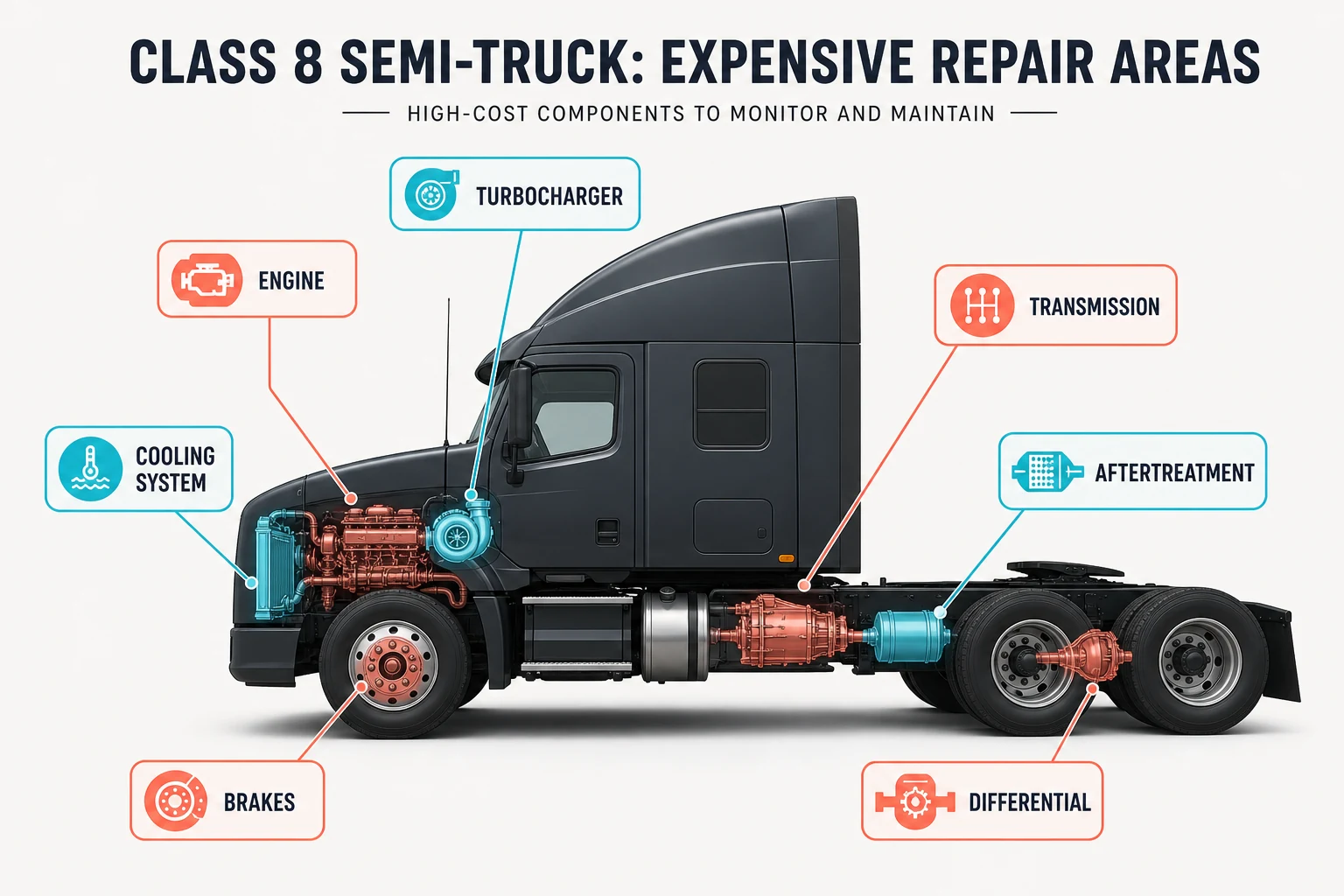
Quick Comparison: Expensive Semi-Truck Repairs
| Repair | Approximate 2026 Cost Range |
|---|---|
| Engine rebuild / overhaul | $15,000–$35,000+ |
| Engine replacement | $20,000–$40,000+ |
| Transmission rebuild | $3,500–$9,000 |
| Transmission replacement | $8,000–$15,000+ |
| Major aftertreatment / DPF / SCR repair | $3,000–$15,000+ |
| Turbocharger replacement | $3,500–$8,500 |
| Fuel injector / fuel-system work | $3,000–$10,000+ in major cases |
| Rear differential rebuild | $3,000–$7,000 |
| Full brake work across multiple axles | $2,000–$5,000+ |
| Radiator / major cooling-system repair | $1,500–$4,500+ |
These ranges can overlap considerably. A relatively simple turbo or emissions repair may stay near the bottom of its range, while a failure that damages other components can become much more expensive.
That is one of the most important things to understand about truck repairs: the component that fails first is not always the only component you end up paying for.
1. Engine Rebuild or Replacement — The Repair Every Owner-Operator Fears
The diesel engine is generally the most expensive major component in a semi-truck, so catastrophic engine damage can produce the largest repair bill.
Heavy-duty engines such as the Cummins X15, Detroit DD15, PACCAR MX-13, Volvo D13, and Mack MP8 are built to operate for enormous mileages. But they still experience wear, and failures involving pistons, liners, bearings, cylinder heads, camshafts, oil systems, or cooling systems can eventually require major internal work.
A 2026 heavy-duty repair estimate from Skyliner Truck Center places a complete truck engine rebuild at approximately $15,000 to $35,000, depending on the engine and amount of internal damage. Its estimates put many Cummins ISX rebuilds around $18,000–$25,000 and Detroit DD15 jobs around $20,000–$30,000.
Other industry estimates place major out-of-frame overhauls or replacement scenarios closer to $20,000–$40,000 or more, especially when extensive damage, dealership labor, or additional components are involved.
What Does an Engine Rebuild Include?
A rebuild can involve much more than replacing one broken part. The engine may need to be partially or completely disassembled so technicians can inspect internal components and determine how much damage has occurred.
Depending on the job, technicians may replace pistons, rings, cylinder liners, rod and main bearings, seals, gaskets, oil pumps, water pumps, and other worn components. Cylinder-head work may also be required.
This is why the final bill can increase significantly after teardown.
A driver may initially bring the truck to the shop because of high oil consumption or low compression. Once the engine is opened, technicians may discover damaged liners, bearings, or a cylinder head that adds thousands of dollars to the original estimate.
In-Frame vs. Out-of-Frame Overhaul
An in-frame overhaul means major engine work is performed while the engine block remains installed in the truck.
An out-of-frame rebuild involves removing the engine from the chassis. This generally requires considerably more labor but allows more extensive inspection and machine work.
An engine that experienced normal high-mileage wear may be a candidate for an in-frame overhaul. Severe internal damage, a damaged block, major crankshaft problems, or catastrophic failure can push the repair toward an out-of-frame rebuild or complete replacement.
When Does Replacing the Engine Make More Sense?
Sometimes rebuilding is no longer financially attractive.
Imagine an older truck worth $40,000 that needs a $30,000 engine repair. Even if the engine is restored, the transmission, emissions system, suspension, differential, and other components still have the mileage of the original truck.
The owner then has to decide whether spending $30,000 on the engine creates enough additional useful life to justify the investment.
For a newer truck in otherwise excellent condition, the answer may be yes.
For a very high-mileage truck with several other expensive problems approaching, replacing the entire truck may make more financial sense.
2. Transmission Rebuild or Replacement
The transmission is another component capable of creating a five-figure repair bill.
Traditional manual transmissions such as Eaton Fuller units are extremely durable, but gears, bearings, synchronizing components, shafts, and other internal parts eventually wear. Modern automated manual transmissions add electronic controls, actuators, sensors, and software that can make diagnosis and repair more complicated.
Current 2026 heavy-duty repair estimates generally put a transmission rebuild around $3,500 to $8,500, with some complex jobs reaching $9,000 or more. A complete installed replacement can cost approximately $8,000 to $15,000.
Automated manual transmissions such as the Detroit DT12 or Volvo I-Shift can become particularly expensive when the problem includes both internal mechanical damage and electronic or actuator-related faults.
Transmission Problems Often Start Small
A complete transmission rarely fails without giving any warning.
A driver might first notice harder shifts, grinding, slipping, unusual noises, delayed gear engagement, excessive heat, or a truck that suddenly shifts differently than normal.
Ignoring these symptoms can allow a relatively manageable problem to turn into internal damage.
A worn clutch, for example, is expensive but usually far less costly than destroying transmission components. The same principle applies to low or contaminated lubricant and problems that cause excessive heat.
Transmission repairs also illustrate why correct diagnosis matters.
Replacing an entire transmission because of an actuator, sensor, wiring, or clutch problem would be an extremely expensive mistake. A qualified shop should determine whether the failure is electronic, mechanical, or a combination of both before recommending major replacement work.
3. DPF, SCR, DEF, and Aftertreatment System Repairs
Modern diesel emissions systems can generate some of the most frustrating repair bills because a driver may have several different fault codes even though the original problem began with one component.
A modern Class 8 diesel truck may use an aftertreatment system containing components such as the Diesel Particulate Filter (DPF), Selective Catalytic Reduction catalyst, DEF dosing equipment, NOx sensors, temperature sensors, pressure sensors, and EGR-related components.
A failed sensor may cost hundreds or perhaps a little over a thousand dollars.
A failed complete aftertreatment system can cost many times more.
Public regulatory cost data have shown OEM DPF replacement quotes ranging from roughly $3,800 to more than $7,000 depending on the engine platform, before considering every possible related repair.
Current heavy-duty repair estimates commonly place major DPF or aftertreatment replacement around $3,000–$8,000, while multi-component failures involving the DPF, SCR, DEF system, sensors, and related equipment can push the final bill toward or beyond $10,000–$15,000.
Why Aftertreatment Repairs Can Become So Expensive
The biggest problem is that one failure can affect another component.
For example, a malfunctioning injector or engine problem may produce excessive soot. That additional soot loads the DPF more quickly. Repeated unsuccessful regenerations can then create additional temperature and pressure problems.
The dashboard may eventually show several codes, but replacing the first component mentioned by a diagnostic code does not necessarily fix the root cause.
Proper diagnosis may require checking live sensor data, exhaust temperatures, differential pressure, DEF dosing, NOx readings, and engine performance.
Simply replacing parts until the warning light disappears can become incredibly expensive.
A Warning About DPF or DEF Deletes
Some owners may be tempted to remove emissions equipment because of repair costs. Tampering with or disabling federally required emissions-control equipment on an EPA-certified vehicle can violate federal law.
A legitimate repair should diagnose and restore the system rather than illegally disabling it.
4. Turbocharger Failure
Modern heavy-duty diesel engines rely heavily on turbochargers to produce power efficiently.
A turbocharger spins at extremely high speed and operates under high exhaust temperatures. Proper lubrication and clean engine oil are therefore extremely important.
When a turbo fails, symptoms may include loss of power, unusual whistling or grinding sounds, excessive exhaust smoke, oil consumption, boost-related fault codes, or poor acceleration.
A complete semi-truck turbo replacement in 2026 commonly costs approximately $3,500 to $8,500, depending on the engine, turbocharger type, labor, and whether the replacement is new, rebuilt, or remanufactured.
The turbo itself may cost several thousand dollars, and the repair can require many hours of labor.
But the biggest concern is often secondary damage.
If a failed turbo sends oil into the intake or exhaust system, additional cleaning or component replacement may be necessary. In severe situations, a turbo failure can contribute to engine damage.
This is why a $4,000 turbo problem should not be ignored until it becomes a $20,000 engine problem.
5. Fuel Injectors and High-Pressure Fuel-System Repairs
Modern diesel fuel systems operate at extremely high pressure and require precise fuel delivery.
Fuel injectors are responsible for delivering the correct amount of diesel at exactly the right moment. A failing injector can cause rough running, poor fuel economy, excessive smoke, hard starting, loss of power, or engine fault codes.
Replacing one injector may be relatively manageable.
Replacing all six injectors on a heavy-duty diesel is different.
Current parts pricing illustrates the potential cost. A set of remanufactured Cummins X15 injectors can cost several thousand dollars, while OEM or manufacturer-remanufactured sets can exceed $6,000 for parts alone before labor and related components are included.
On some ISX15 applications, new OEM injectors can be priced around $1,600–$2,100 or more each, with additional labor for installation.
Fuel-pump problems can increase the bill further.
The worst scenario occurs when a failing high-pressure pump contaminates the fuel system with metal debris. Instead of replacing only a pump, the repair may involve lines, injectors, rails, cleaning, and additional components.
That can turn a relatively localized fuel-system problem into a repair costing many thousands of dollars.
Why Fuel Problems Should Be Diagnosed Quickly
A truck that suddenly becomes difficult to start or begins running poorly should not automatically be driven until it completely fails.
A bad injector can contribute to poor combustion, increased soot production, DPF problems, fuel dilution of engine oil, or cylinder damage.
Once again, the expensive part is often not the original failed component.
It is the damage caused by continuing to operate the truck after the warning signs appeared.
6. Differential and Rear-End Repairs
The rear differential transfers power from the driveshaft to the drive wheels while allowing the wheels to rotate at different speeds when the truck turns.
It operates under enormous loads, especially when a truck spends its life hauling heavy freight.
Differentials normally contain gears, bearings, seals, and lubricant designed to survive hundreds of thousands of miles. But low lubricant, contamination, worn bearings, damaged gears, or extreme operating conditions can eventually cause failure.
Heavy-duty repair estimates commonly put a rear differential rebuild around $3,000 to $7,000, depending on the axle and amount of damage.
The repair may require removal and disassembly of the differential so technicians can inspect bearings, gears, the ring and pinion, and related components.
A driver may notice a developing differential problem through whining, grinding, vibration, unusual drivetrain noise, or evidence of leaking lubricant.
These symptoms should not be ignored.
If a relatively inexpensive seal leak causes the differential to lose enough lubricant, the result can eventually be destroyed gears and bearings.
That is a perfect example of a small repair turning into a several-thousand-dollar rebuild.
7. Major Brake Repairs
Brake repairs are routine maintenance on commercial trucks, but the cost becomes significant when multiple axles need substantial work at the same time.
A normal brake service on one wheel end may not qualify as one of trucking's most expensive repairs. But replacing drums, shoes or pads, chambers, calipers, hardware, and other components across several axles can produce a bill of several thousand dollars.
One 2026 repair guide places complete brake work around $800 to $2,500 per axle, depending on the parts required.
Across a tractor and trailer, that can add up quickly.
Unlike some repairs that can potentially be scheduled, brake defects can also make the truck unsafe or place it out of service.
A driver who hears unusual brake noises, feels the truck pulling during braking, notices an air leak, or finds damaged components during a pre-trip inspection should report the issue immediately.
Delaying brake repairs is not a reasonable way to save money.
8. Cooling-System and Radiator Failure
Compared with an engine replacement, a radiator may seem inexpensive.
But a cooling-system failure deserves a place on this list because ignoring it can destroy an engine.
A semi-truck radiator replacement currently commonly falls around $1,500–$4,500, although premium equipment or additional cooling-system work can push the bill higher.
The radiator is only one part of the system. A repair could also involve hoses, coolant, thermostats, water pumps, fan clutches, reservoirs, sensors, or other components.
The dangerous part is overheating.
If a coolant leak or failing radiator causes the engine to operate at excessive temperature, the result can include damaged cylinder-head components, head-gasket problems, or severe internal engine damage.
A driver who continues operating an overheating engine to avoid a $2,000 repair can potentially create a $20,000 repair instead.
Watching coolant temperature and checking for leaks during pre-trip inspections is therefore extremely important.
Why the Final Repair Bill Can Be Much Higher Than the Failed Part
A common mistake is searching online for the price of one component and assuming that represents the complete repair cost.
Suppose a turbocharger costs $3,000.
The final invoice may also include diagnosis, removal and installation labor, gaskets, oil lines, coolant, engine oil, filters, cleaning of intake or exhaust components, shop supplies, taxes, and additional parts discovered during the repair.
A similar situation occurs with engines and transmissions.
The shop may quote a base rebuild package, but once technicians open the unit they may discover hard-part damage that was impossible to confirm externally.
Location matters too.
Heavy-duty shop labor can vary significantly around the country. One 2026 shop guide in Northeast Pennsylvania reports rates around $150–$200 per hour for heavy truck work.
Dealer labor can also be more expensive than independent-shop labor, although a dealer may have advantages involving OEM diagnostic equipment, updated software, technical support, warranty coverage, and parts access.
The Hidden Cost: Downtime
A $10,000 repair does not necessarily cost the owner only $10,000.
Suppose an owner-operator's truck spends eight days in the shop waiting for parts.
During those eight days, the truck may generate no freight revenue.
But expenses can continue:
Truck payments may still be due. Insurance remains active. Trailer payments or rental expenses may continue. Permits, subscriptions, phone bills, and other business costs do not disappear because the engine is apart.
The owner may also lose scheduled loads or relationships with customers.
For a fleet, one broken truck may require moving the driver into another tractor, renting equipment, redistributing freight, or rescheduling deliveries.
This is why repair time can be almost as important as repair price.
A $7,000 repair completed tomorrow may sometimes be financially better than a $6,000 repair that leaves the truck parked for another week.
Should You Choose OEM, Remanufactured, or Aftermarket Parts?
This decision can change a repair bill significantly.
OEM parts come from the original manufacturer or its approved supply chain. They are usually the most expensive option but may provide strong compatibility and warranty support.
Remanufactured components are used components that have been disassembled, inspected, repaired, and rebuilt to a defined specification. Engines, transmissions, turbos, injectors, and differentials are all available in remanufactured form.
A quality remanufactured component can sometimes save thousands of dollars.
Aftermarket parts are manufactured by another supplier. Quality can vary dramatically. Some aftermarket manufacturers produce excellent commercial components, while very cheap parts may create additional failures and labor costs later.
The cheapest component is therefore not automatically the cheapest repair.
If replacing a difficult-to-access $1,000 component requires $2,000 in labor, saving $200 on a low-quality part makes little sense if that part fails again six months later.
Warranty coverage should always be considered when comparing major repair options.
Dealer vs. Independent Diesel Shop
Dealerships and independent truck shops both have advantages.
A dealership may have direct access to manufacturer diagnostic systems, software updates, technical documentation, OEM parts, and warranty procedures.
That can be especially useful for complicated electronic, engine, transmission, and aftertreatment problems.
Independent diesel shops may offer lower labor rates and more flexibility regarding remanufactured or aftermarket components.
A good independent technician with extensive experience on your specific engine can sometimes diagnose a problem more efficiently than a shop that immediately begins replacing expensive components.
The most important factor is not simply whether the sign outside says "dealer" or "independent."
It is whether the facility can accurately diagnose the problem and stand behind the repair.
For a $20,000 engine job, getting another qualified opinion can be worthwhile if the diagnosis is uncertain.
When Should You Repair the Truck and When Should You Replace It?
This can be one of the hardest decisions for an owner-operator.
A $25,000 engine repair sounds enormous, but buying another truck may require considerably more money.
At the same time, installing a rebuilt engine in an older tractor does not make the rest of the truck new.
Before approving a very large repair, consider the truck's overall condition, mileage, resale value, maintenance history, transmission condition, aftertreatment system, suspension, electrical problems, and expected future use.
Imagine two trucks that both need $25,000 engine work.
Truck A is otherwise in excellent condition, has a recently rebuilt transmission, good aftertreatment system, and a documented maintenance history.
Truck B has 900,000 miles, transmission problems, repeated DPF faults, worn suspension, and significant electrical issues.
The same $25,000 engine repair may make financial sense for Truck A and very little sense for Truck B.
The decision should be based on the entire truck, not only the failed component.
How Can Truck Drivers Reduce the Risk of Major Repairs?
No maintenance program can guarantee that a truck will never experience a major failure.
Commercial trucks work hard, often covering more than 100,000 miles per year under heavy loads and demanding weather conditions.
But preventive maintenance can reduce the chance that smaller problems become catastrophic.
Regular oil and filter service protects the engine and turbocharger. Cooling-system maintenance helps prevent overheating. Proper transmission and differential lubrication protects gears and bearings. Correct tire pressure reduces stress and operating costs.
Daily inspections matter too.
A driver may be the first person to notice a coolant leak, unusual vibration, oil leak, new engine sound, difficult shift, excessive smoke, or warning light.
Those signs should be treated as information rather than annoyances.
Many extremely expensive truck repairs begin with a symptom that was present long before the component completely failed.
Build a Maintenance Reserve Before You Need It
Major repairs are particularly dangerous to owner-operators who have no money reserved for maintenance.
If the truck requires a $12,000 repair and the business has only $2,000 available, the owner may be forced to use expensive financing, credit cards, borrow money, or leave the truck sitting while trying to find funds.
A maintenance reserve changes the situation.
The correct amount depends on the age of the truck, mileage, monthly miles, warranty, and operating conditions. Older high-mileage trucks generally require a larger reserve than new equipment under comprehensive warranty.
The latest ATRI data reinforce why maintenance budgeting matters: repair and maintenance expenses rose 8.6 percent in 2025, one of the largest increases among major trucking operating-cost categories.
A repair fund may feel like money that is doing nothing when the truck runs perfectly.
When a transmission fails, that money suddenly becomes one of the most important assets in the business.
Common Warning Signs You Should Never Ignore
Catastrophic repairs often begin with small changes in how the truck operates.
A driver should take unusual engine noises, reduced power, excessive smoke, rising coolant temperature, repeated regeneration problems, oil or coolant loss, difficult shifting, drivetrain vibration, unusual turbo sounds, and persistent warning lights seriously.
One warning light does not automatically mean the engine needs a $25,000 rebuild.
But repeatedly clearing a fault code without determining why it returns is not a maintenance strategy.
The objective should be to diagnose problems while they are still relatively small.
A leaking coolant hose is inexpensive compared with an overheated engine.
A leaking differential seal is inexpensive compared with destroyed gears.
A turbo actuator problem is cheaper than a complete turbo.
And a repairable engine problem is much cheaper than catastrophic engine failure.
Frequently Asked Questions
What Is the Most Expensive Semi-Truck Repair?
A major engine rebuild or complete engine replacement is usually among the most expensive single repairs. Depending on the engine and severity of the failure, the cost can reach roughly $15,000–$35,000 or more, with particularly extensive jobs potentially approaching or exceeding $40,000.
How Much Does It Cost to Replace a Semi-Truck Transmission?
A complete installed heavy-duty transmission replacement can commonly cost around $8,000–$15,000, depending on the transmission and damage involved.
How Much Does a Semi-Truck Turbo Cost to Replace?
Current 2026 estimates commonly put complete turbocharger replacement around $3,500–$8,500.
Can DPF Problems Cost Thousands of Dollars?
Yes. A sensor or forced regeneration may be relatively inexpensive, but DPF, SCR, and multi-component aftertreatment failures can cost several thousand dollars and can reach five figures in complex cases.
Is It Worth Rebuilding a Semi-Truck Engine?
It depends on the value and overall condition of the truck. Rebuilding can make sense when the tractor is otherwise in good condition and has many useful years remaining. It may make less sense when several other major components are also near the end of their service life.
Can Preventive Maintenance Really Save Money?
Yes. Maintenance cannot prevent every failure, but discovering leaks, overheating, contamination, low fluid levels, worn components, and abnormal operation early can prevent secondary damage that dramatically increases the final repair bill.
Final Thoughts
Semi-trucks are designed to work for hundreds of thousands of miles, but they are not inexpensive machines to repair.
The biggest financial risk is usually the engine, where a major rebuild or replacement can cost tens of thousands of dollars. Transmission failures can also reach five figures, while aftertreatment systems, turbochargers, fuel systems, differentials, brakes, and cooling systems can each create substantial bills.
But the price of the component is only part of the cost.
A serious breakdown can also mean towing, diagnostics, hotel expenses, lost loads, missed deliveries, and days or weeks without revenue.
That is why professional maintenance is so important.
Perform thorough pre-trip inspections. Pay attention to changes in how the truck drives. Watch fluid levels and temperatures. Do not ignore leaks, warning lights, smoke, unusual sounds, or shifting problems. Follow appropriate maintenance intervals and keep enough money reserved for unexpected repairs.
A $500 problem discovered early may remain a $500 problem.
The same problem ignored for another 50,000 miles can potentially become a $20,000 repair.
For owner-operators especially, taking care of the truck is not simply maintenance.
It is protecting the equipment that makes the business money.
